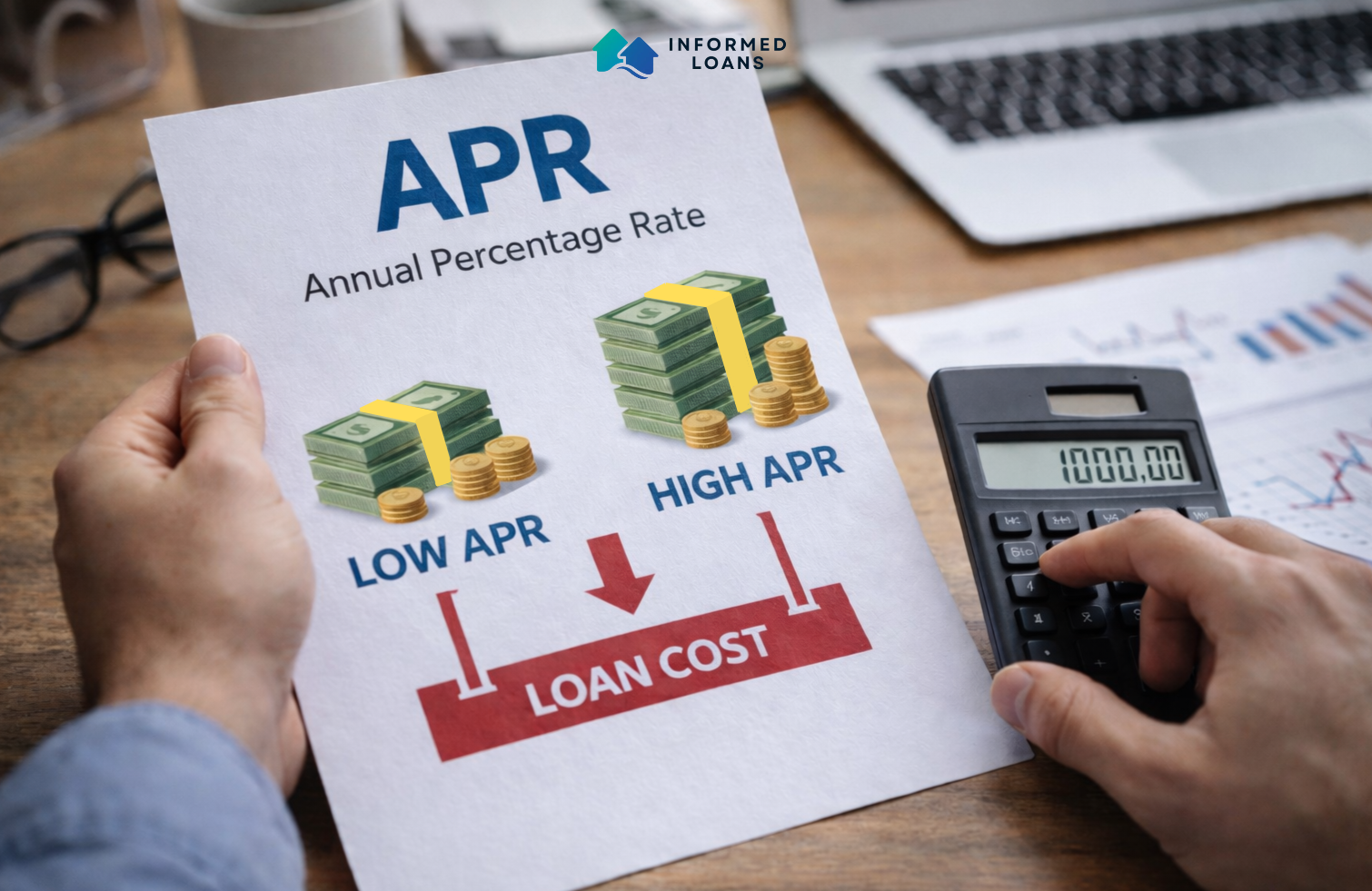
When you're looking at financing options, one number stands out: APR. The Annual Percentage Rate (APR) goes beyond just the interest rate to give you a clear view of a loan's cost over time. This is vital, especially in commercial lending and hard money financing, where fees and short repayment terms can significantly impact the cost.
For investors and business owners who need quick capital, understanding APR can make the difference between a profitable deal and one that quietly loses money. Whether you're evaluating a bridge loan, a fix-and-flip loan, or a large commercial property purchase, APR allows you to compare offers accurately. If you're exploring flexible financing, our bridge loans and fix-and-flip loans go beyond the stated rate.
Back in 2026, commercial lending took off as borrowing confidence improved. Commercial real estate (CRE) lending surged by 112% year-over-year, fueled by Federal Reserve rate cuts and renewed deal flow. In a competitive market, speed matters, but so does the total cost of capital. For a broader look, check out our commercial real estate financing guide.
To help you make smarter decisions, this guide breaks down what APR is, how it's calculated, why it matters for commercial and hard money loans, and how to use it when assessing real-world loan offers.
What APR Actually Means
APR vs. Interest Rate
Think of APR as the “all-in” annual cost of borrowing. The interest rate covers the cost of the money itself, but APR includes that rate plus certain lender fees and financing charges. A loan with a low interest rate can still be pricey if the fees are high.
Comparing only monthly interest payments can mislead you. Two loans may look similar on paper, but if one includes origination points, underwriting fees, or service fees, the effective cost can be much higher. Resources like Fidelity's APR explanation and the Consumer Financial Protection Bureau emphasize that APR helps borrowers compare the true cost of different credit products.
Why APR Matters in Commercial and Hard Money Lending
APR is even more crucial in commercial and hard money loans, which often have more significant fees than standard residential mortgages. Hard money loans may cost more because they focus on speed, collateral, and flexibility over traditional underwriting. APR is key to evaluating whether the financing supports the project’s expected returns.
For instance, a borrower might choose a loan because it closes in days rather than weeks. That speed can be invaluable in a competitive acquisition or renovation scenario. But if the APR is too high relative to the projected profit margin, the deal may be less attractive. If fast execution is vital, our equity-only real estate loans offer asset-based flexibility.
How APR Is Calculated
Core Components of APR
APR is calculated by adding eligible loan fees to the interest rate, then annualizing the result over the loan term. While formulas vary by lender and loan type, the goal is always the same: show the cost of borrowing in a standardized way. The included fees often determine how much APR differs from the nominal rate.
Common fees that influence APR include origination points, processing fees, underwriting fees, broker fees, and certain administrative or closing costs. Borrowers should ask lenders which fees are included in the APR calculation. The Federal Reserve and SEC provide resources on lending disclosures and consumer credit transparency.
Effective APR vs. Stated Rate
Some lenders advertise an appealing stated interest rate, but the effective APR may be much higher due to points and fees. This is especially true for short-term loans, where fees have a larger impact because they amortize over a shorter period.
Imagine two hard money loans, both charging 12% interest. If one includes upfront points and the other minimal fees, their APRs can differ greatly. That difference may not be obvious unless you request a full cost breakdown. Borrowers evaluating financing for a purchase or rehab project should compare both the interest rate and the APR.
Current Market Trends Affecting APR in 2026
Commercial Lending Growth and Borrower Confidence
The 2026 lending environment brought new opportunities and complexities. As commercial real estate activity expanded, many borrowers returned to the market with renewed confidence, especially in sectors where timing and flexibility are essential. Faster credit decisions and aggressive capital deployment made hard money loans more attractive for certain deals.
That trend matters because rising demand can affect pricing, fee structures, and lenders’ willingness to negotiate. In a market with more active borrowing, lenders may adjust terms based on property type, exit strategy, and borrower experience. If you’re considering a larger deal, our commercial real estate financing solutions can help evaluate structures that align with your project’s timeline.
Hard Money Loan Pricing in 2026
Research shows that hard money loan rates in 2026 ranged from 10% to 15%, with additional fees like origination points and processing charges. This reflects the risk profile and speed associated with these loans. For many, the draw is quick capital access when conventional financing is too slow or restrictive.
Conventional commercial loan rates were estimated between 6% and 10%, while SBA 504 loans ranged from 5% to 7%. These lower rates can be appealing, but they often involve more documentation, underwriting, and longer closing times. Understanding APR helps borrowers see whether the convenience of hard money is worth the higher borrowing cost. For more context on loan structure, our commercial vs. residential loan guide is a useful resource.
Why APR Is So Important for Real Estate Investors
It Clarifies Profitability
Real estate investors often focus on purchase price, rehab budget, and resale or rental income. Those are key, but financing costs can quietly erode returns if not carefully measured. APR gives you a better understanding of whether a deal still makes sense after considering all costs.
For flip projects, a few percentage points can significantly affect net profit. For rental investments, borrowing cost impacts cash flow and refinancing options. If you're building a portfolio and want financing tied to property performance, a DSCR real estate investment loan may offer a strong structure based on cash flow rather than personal income.
It Helps Compare Different Loan Types
APR is especially useful when comparing different loan products. A hard money loan may have a higher rate but a faster close, fewer documentation requirements, and a simpler approval process. A conventional loan may have a lower rate but take longer and require more documentation.
That's why APR should be viewed alongside the project timeline. If a fast close helps secure a deal below market value, a higher APR may be acceptable. If the project has a longer hold period and predictable income, a lower-cost loan could be the better choice. If you're self-employed or have variable income, our NON-QM investment loans offer flexible qualification options.
Real-World Example: A Commercial Deal in Arlington Heights
When Speed Creates Value
Consider an investor in Arlington Heights, IL, who finds a commercial property priced below comparable sales. The opportunity is strong, but the seller wants a quick close. Traditional financing would take too long, so the investor chooses a hard money loan to secure the property before competitors step in.
On paper, the interest rate might appear manageable. But once origination points, underwriting fees, and other costs are added, the APR rises enough to affect the project’s margin. If the business plan only works with a narrow profit spread, the investor must decide whether speed is worth the extra cost. Sometimes, the answer is yes because faster funding protects the deal itself.
How to Evaluate the Tradeoff
A smart borrower doesn't just ask, “What is the rate?” The better question is, “What will this financing cost me in total, and what value does it create?” That's where APR becomes a decision-making tool, not just a disclosure number. In a deal with strong upside, a higher APR can still be justified.
For investors who want to model timing and cost accurately, it helps to compare the loan to the expected project timeline. A 6-month rehab has a very different financing profile than a 24-month rental stabilization or value-add repositioning. If you need temporary capital while moving from acquisition to permanent financing, our bridge loan explainer can help you understand that transition.
Questions Borrowers Should Ask Before Signing
What Fees Are Included in APR?
One of the most important questions is which charges were used to calculate APR. Some fees may be included, while others may not, depending on the loan structure and disclosure rules. Borrowers should request a full fee sheet and ask the lender to explain how the APR was derived.
This is crucial for commercial and hard money loans, as fee structures vary more widely than in standard financing. If something seems unclear, ask for a side-by-side comparison of the stated rate, upfront fees, and projected all-in cost over the expected term. Clear documentation can prevent unpleasant surprises later.
What Is the Payoff Timeline?
APR is more meaningful when viewed in the context of how long you expect to hold the loan. A loan with higher fees may look worse over a long period, but if you plan to exit quickly, the impact may be manageable. On the other hand, a short-term loan that renews multiple times can become expensive fast.
That's why an exit strategy matters as much as the interest rate. Will you refinance, sell, or pay off from operating income? The stronger and more realistic your plan, the easier it is to judge whether the APR is acceptable. If you're weighing time-sensitive acquisition opportunities, our ground-up construction loans and multi-family loans may offer options for larger project timelines.
Best Practices for Comparing Loan Offers
Compare Total Cost, Not Just Monthly Payment
The monthly payment is only part of the financing puzzle. In many commercial loan scenarios, two offers with similar payments can still have different APRs because one includes larger upfront charges. Borrowers should compare total borrowing cost over the expected life of the loan, not just the monthly due amount.
It also helps to evaluate prepayment flexibility. Some loans may have better APRs but include prepayment penalties or other restrictions that reduce their usefulness. If you expect to exit early, those terms can be just as important as the rate itself. A strong financing decision balances cost, flexibility, and timing.
Use a Scenario-Based Approach
Instead of looking at one number in isolation, run multiple scenarios. Ask what happens if the project finishes on time, three months late, or requires more renovation capital than expected. The loan with the lowest nominal rate is not always the cheapest if delays cause additional interest, fees, or extension charges.
For many borrowers, the best method is to analyze the loan using both best-case and conservative assumptions. This approach shows whether the project can survive unexpected setbacks. It also helps determine whether a slightly higher APR is acceptable in exchange for a more forgiving structure. For borrowers seeking flexibility on collateral-based deals, SFR, condo, and 2–4 unit investment financing can be a practical fit.
How APR Affects Different Loan Types
Hard Money Loans
Hard money loans usually carry the highest APR among common real estate financing products because they are designed for speed and flexibility. Lenders focus more on property value and exit strategy than on extensive income verification. That makes them useful for distressed assets, fast purchases, and time-sensitive renovations.
However, borrowers should remember that the stated interest rate is only part of the equation. Points, origination charges, and processing fees may materially increase the effective APR. When the deal relies on a short holding period, those costs need to be built into the budget from day one.
Commercial Loans
Commercial loans typically have lower APRs than hard money products, but they may involve more underwriting and documentation. Borrowers should still examine the effective rate carefully because commercial closings can include appraisal fees, legal review, and other transaction costs. A low rate is useful only if the total borrowing cost still fits the project economics.
If you are financing an office, retail, warehouse, or mixed-use property, understanding APR can help you decide whether a conventional loan or a more flexible structure makes more sense. Our commercial real estate financing page outlines options for borrowers evaluating larger assets and varied property types.
Bridge Loans and Construction Loans
Bridge loans and construction loans often sit in the middle between conventional and hard money financing. They may be more flexible than bank loans, but still require close attention to fees and term length. Because these products are usually temporary, APR should be examined alongside the planned refinance or sale date.
That means the borrower must understand the next step before closing. If the bridge loan gets you from purchase to repositioning, what happens after that? A thoughtful capital stack can make the APR easier to absorb because the loan serves a specific, time-limited purpose.
FAQ: APR and Loan Cost Basics
Is APR always higher than the interest rate?
Usually, yes, because APR includes the interest rate plus qualifying fees. In some cases, the APR may be close to the stated rate if fees are low. For borrowers, the key point is that APR is generally the more complete measure of cost.
Does a lower APR always mean a better loan?
Not necessarily. A lower APR can be attractive, but it may come with slower funding, stricter underwriting, or less flexibility. For time-sensitive opportunities, a slightly higher APR may still be the smarter choice if it helps secure the property or complete the project.
Should I use APR for every loan comparison?
Yes, especially when comparing products with different fee structures. APR is one of the best tools for comparing offers in a standardized way. Still, you should combine it with practical considerations like closing speed, repayment terms, and your exit strategy.
How Informed Loans Helps Borrowers Make Smarter Decisions
Practical Guidance for Investors and Business Owners
At Informed Loans, we help clients look beyond the headline rate and focus on the real economics of a deal. That means reviewing fees, timing, collateral, and repayment plans together so borrowers can choose financing that supports their goals. In many cases, the best loan is the one that balances speed, certainty, and cost.
Whether you are pursuing a fix-and-flip project, a commercial acquisition, or a cash-out refinance backed by equity, the right structure should support the project rather than strain it. Borrowers who understand APR are better prepared to negotiate, compare, and close with confidence.
Next Steps for Borrowers
If you are evaluating a new loan, start by requesting a complete fee breakdown and asking how the APR was calculated. Then compare that number with the expected return from the property or business opportunity. The closer you get to a true all-in cost analysis, the better your decisions will be.
For more strategic guidance, explore our related resources on hard money lending trends and the 2026 commercial lending surge. If you would like to discuss a financing scenario directly, contact Informed Loans at (833) 574-1629 or visit us at 21 S Evergreen Ave #210, Arlington Heights, IL 60005. Understanding APR is the first step toward borrowing wisely—and the right financing partner can help you put that knowledge to work.
Conclusion: Use APR to Borrow With Clarity
APR is one of the most useful tools a borrower can use when comparing loan options. It helps reveal the total cost of financing, not just the advertised rate, which is especially important in commercial and hard money lending. When fees, speed, and short-term structures are involved, that clarity becomes essential.
The strongest borrowers are the ones who combine good opportunities with disciplined financing analysis. If you can measure cost accurately, compare offers intelligently, and match the loan to the project timeline, you put yourself in a much better position to succeed. Before signing your next agreement, make APR part of your decision process—and make sure the deal works on paper as well as in practice.